
story by SCOTT ROBERTS, OI staff
There’s lots to do at DNR properties for Hoosiers of all abilities.
A granddaughter in a wheelchair with a broken leg hikes with her family. A son with autism can enjoy exhibits at an interpretive center because of a smartphone app. And a woman with sore knees can hunt waterfowl with her family thanks to an accessible blind. Each of them and many more have found a special place at Indiana’s Department of Natural Resources that welcomes them and suits their needs. Thanks to accessible features at DNR properties, Hoosiers with a broader range of abilities can enjoy Indiana’s natural landscapes.
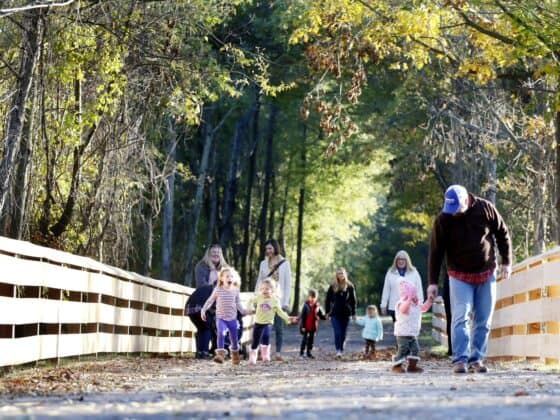
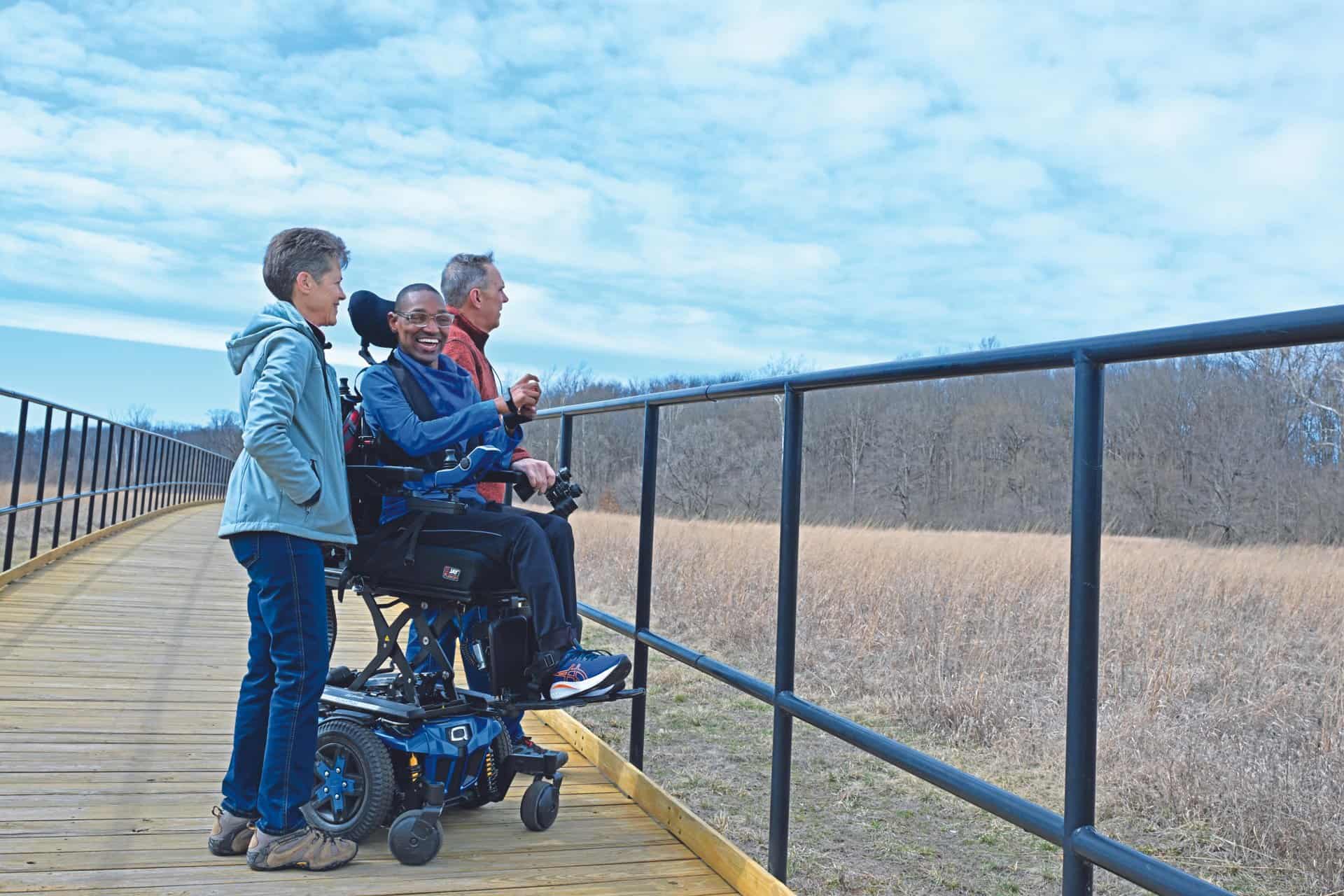
Prophetstown State Park’s paved bike/hike trail has become a favorite of Angela Humphrey of Lafayette. It’s 3.5 miles long, accessible, and connects most of the park’s wide variety of features. She’s a counselor for OASIS of West Lafayette, a community for people with intellectual and developmental disabilities. One of its activities is an outdoor club through which residents gather once a month to do activities in nature. For the past couple of years, a visit to Prophetstown has been one of them.
Humphrey also visits Prophetstown a few times a year with her family, as her 20-year-old son, Ian, is able to navigate the trail with his motorized wheelchair, which he also uses to access flat, mowed areas. “The more independence he feels like he has, the happier he is,” Humphrey said.
Duane and Dana Hunt of Indianapolis love to camp with family. When their granddaughter Joy, then a tween, broke her leg in 2007, they looked for a park that had accessible areas she could get to in her wheelchair while she recovered. After some online searching, they found O’Bannon Woods State Park’s Tulip Trail. The first mile of this two-mile trail is a flat surface that’s accessible to people with disabilities, so the family reserved a campsite. What they found at the state park near Corydon was more than they expected. Joy was also able to access the park’s Hickory Hollow Nature Center and its 1850s working haypress, which the Hunts said she also enjoyed.
Kim Ousley of Anderson is able to hike and volunteer at Mounds State Park’s Nature Center and Bronnenberg House with her prosthetic leg thanks to the park’s flat ground and accessible areas. She can walk the park’s Trail 1, an easy hike on which portions are wheelchair accessible, while enjoying many of the park’s features, including the Great Mound, its largest earthwork. She also can walk to the canoe launch, where she likes to sit on a bench and take in her surroundings. “I like to watch the water and birds and see the canoers and kayakers go by,” Ousley said.
James Anderson has hunted waterfowl for most of his life. He got his wife Marianna interested in the sport when she retired about five years ago. Finding a place where both could hunt was a challenge for the North Manchester couple because Marianna has knee problems that make it difficult for her to walk and stand for long periods of time.
About two years ago they heard about Tri-County Fish & Wildlife Area’s accessible hunting blind on Shock Lake near Princeton, where their son, James Jr., lives. “There’s a nice sidewalk leading up to the blind, I’d say it’s about a 30-foot walk, and it’s level,” Marianna’s husband said. “So
many other places don’t have that kind of access.”
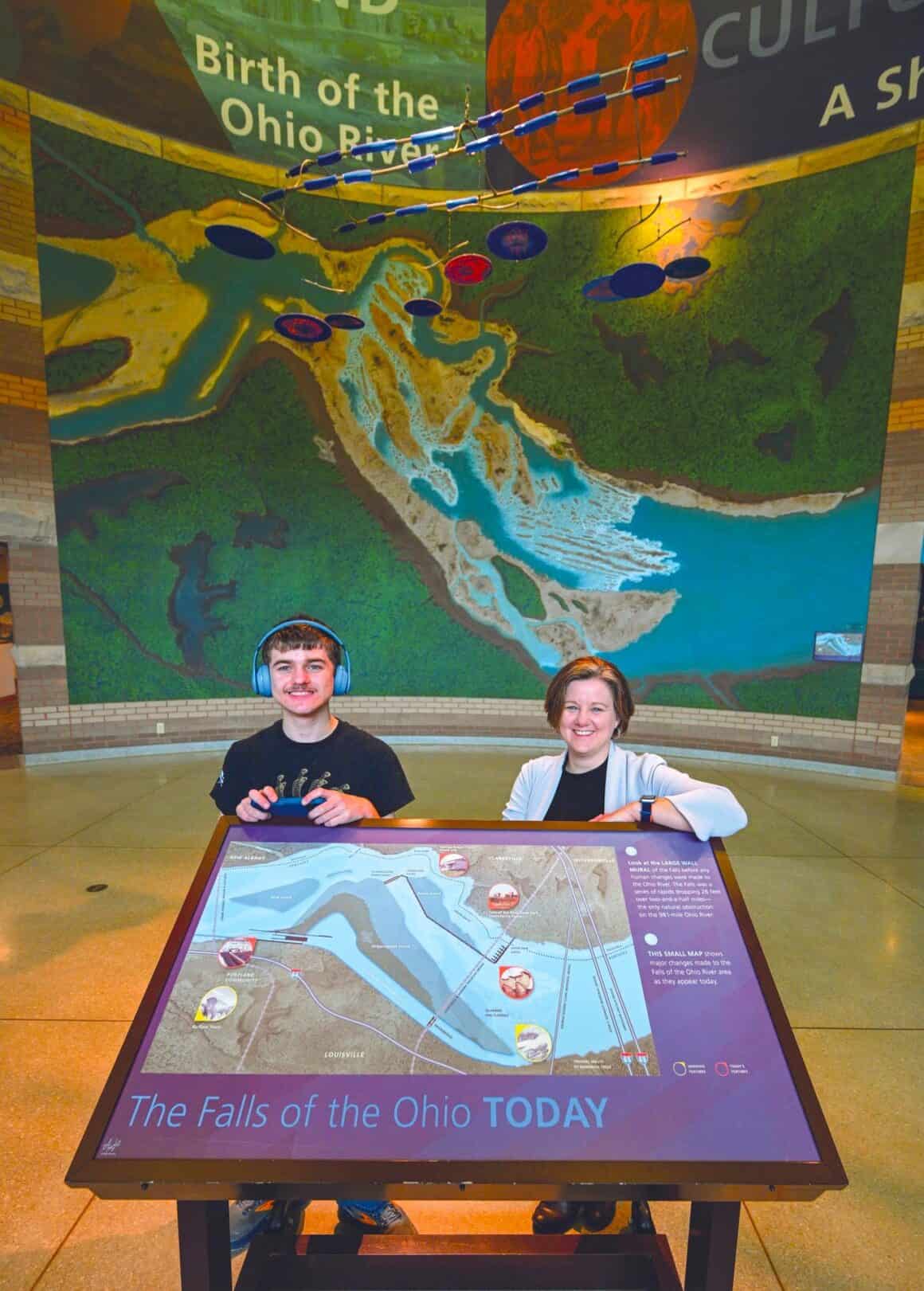
When Mandie Creed’s son Dylan was diagnosed with autism about 10 years ago, she realized it was tough for him to visit museums because he would get overwhelmed by the flood of information. An audio-visual entertainment engineer, Mandie has worked for years designing exhibits for museums across the country, and she wanted to create a way for her son and others like him to enjoy museums, too. She created a smartphone app that explains exhibits in a more understandable way while eliminating distractions. She had worked with Falls of the Ohio State Park in the past, and the park’s interpretive center agreed to become the test site for
her app, which is available at no cost.
When the app neared completion, she had Dylan test it. When he’d visited the Falls of the Ohio Interpretive Center before, without the app, he’d spend maybe 20 minutes in the area, and she said he didn’t seem very engaged. With the app, he spent 90 minutes and was so into it he flipped the exhibit’s levers himself. “It was the first time he had engaged with any exhibit in a museum, and when I saw him there, I thought, ‘OK, even if no one else uses this app, it was worth it for me to have him use this,’” Creed said.
DNR staff constantly work to create accessible options for guests who need them. A website, on.IN.gov/dnr-accessibility, provides an updated list of opportunities and describes what people with disabilities can do, organized by activity and property. It includes many options not already
mentioned. Two examples are mobility mats to let those in wheelchairs get on a beach and viewing platforms with lower railings with binoculars that allow people in wheelchairs to get a clear view of wildlife, and there are many more.
If you need assistance, call the property you want to visit. They’ll work to accommodate your needs so you can enjoy Indiana’s outdoors, too.